
How to Read a Three Card Tarot Spread
What does a three card spread actually show?
A three card spread is a short sequence of three positions, and each position answers one part of a single question. The cards are not three separate readings that happen to sit side by side. They form one sentence: the first card sets the subject, the second adds what is happening around it, the third shows where that leads if nothing changes.
This is why three cards read together say more than three separate meanings. Take The Tower, the Three of Cups and the Eight of Pentacles. Pulled apart they read as upheaval, celebration and steady work. Read in order they tell a story about a disruption that opens room for support, then asks for patient effort. Order matters: position carries as much information as the card itself.
- Past, present and future, the most common framing.
- Situation, action and outcome, useful when you want a decision.
- You, the other person and the space between you.
- What helps, what hinders and what to do next.
How should I phrase my question?
Phrase your question so it invites detail rather than a single-word answer. Open questions starting with how or what give each position room to offer context, which helps you understand how to read a three card tarot spread more clearly.
- Weak phrasing: "Will I get the new job?"
- Strong phrasing: "What factors should I focus on during my job search?"
- Weak phrasing: "Should I stay in my relationship?"
- Strong phrasing: "How can I improve communication with my partner?"
Simple yes-or-no questions waste the three positions because individual cards rarely mean a plain positive or negative. A spread works best when each card answers a distinct angle of your query, such as past influences, present obstacles, or practical next steps.
Which three card layouts can I use?
Three cards give you a frame for the reading, and the frame decides what each position means. Past, present, future suits a broad question about how a situation developed. Situation, action, outcome works better when you already know what you are dealing with and want to weigh a next step. Option one, option two, guidance fits a choice between two paths.
| Layout | Positions | Best for |
|---|---|---|
| Past, present, future | What led here, where you stand, where it is heading | Open questions about a situation you have not narrowed down |
| Situation, action, outcome | What is happening, what you can do, what follows | Questions where you are ready to act |
| Option one, option two, guidance | First path, second path, what to weigh | Two concrete choices, such as staying or leaving |
Choose the layout before you shuffle, not after you see the cards. If the question changes halfway through, the positions stop meaning anything and you are left reading three cards with no frame.
How do I read the cards as one story?
Reading cards as a single narrative means treating them as subject, verb and outcome rather than three isolated symbols. Learning how to read a three card tarot spread works best when you trace how each card modifies the one before it.
For example, if you draw the Three of Swords, the Two of Pentacles, and the Ten of Cups, start with the initial grief of the Three of Swords. The Two of Pentacles follows, showing that managing practical daily routines balances that emotional pain rather than ignoring it. Finally, the Ten of Cups closes the sequence by resolving the effort into long-term emotional stability and peace.
Connecting the cards in a clear narrative arc keeps your reading focused on practical insight instead of disconnected meanings.
What if a card seems to contradict the others?
A contradiction is usually tension inside the story, not a mistake in your reading. A reversed card, a court card that stands apart from the rest, or a suit that clashes with its neighbours all point to something pulling in two directions at once.
Reversals often soften or delay a card rather than cancel it. A court card can show a person or a role you are taking on, which is why it sometimes feels out of place next to plain pip cards. Mixed suits work the same way: Cups and Swords side by side usually mean feeling and thinking are not yet agreed.
- Name the tension in one sentence: "Part of me wants to stay, and part of me is already planning to leave."
- Check the middle card, which often holds the two outer cards together.
- Ask which card describes the situation and which describes your reaction to it.
- Treat a reversal as a quieter version of the same card, not its opposite.
- Read a lone court card as a role or a person, then ask who it belongs to.
How do I finish a reading without predicting the future?
To wrap up your draw, turn the message of the cards into one single action you can take this week. Treat the final position as a direction rather than a fixed outcome. Viewing the last card as the direction your current choices are heading helps you read the spread as a guide for personal growth.
State your main takeaway in plain words and keep the focus on what you can control today. You can close the session with these quiet steps:
- Summarise the overall message in one active sentence.
- Choose one specific task to complete over the next few days.
- Take a clean, deep breath to mark the end of the draw.
- Put the deck back in its pouch or box to step away from the session.
How do I practise reading three cards?
Practise with one question a day, not a full session. Ask something small and answerable, shuffle, and lay three cards face up. Read them as one story using the layout you know best, then write a single sentence that says what the three cards together suggest. One sentence is enough. Longer notes turn into interpretation, and you stop noticing what you actually saw.
- Write the question down before you shuffle, in the same words you asked yourself.
- Lay the three cards and name the position each one holds, such as past, present, future.
- Say the story out loud in one sentence, then write that sentence down.
- Date the entry so you can find it again a week later.
- Review once a week and mark what changed in the situation and what did not.
If you want a starting structure for the daily question, the guide to reading a three card tarot spread walks through phrasing and layouts. Keep the sentence and skip the verdict.
Frequently asked questions
Do I have to use past, present and future?
No. Past-present-future is the most common framing, but it is only one option. Situation-action-outcome works better for decisions, and option one-option two-guidance works when you are choosing between two paths. Pick the layout that matches your question, not the other way round.
Can I read a three card spread for someone else?
Yes, and the same rules apply. Ask them for one clear question, lay the three cards, and describe what you see in plain words. Let them connect the cards to their own life instead of telling them what will happen.
What if I pull the same card twice in one spread?
Treat the repeat as emphasis, not a mistake. The card is showing up in two positions, so it carries weight in both parts of the story. Read the two positions together and ask what that card is asking the querent to notice.
How long should a three card reading take?
A focused reading usually takes ten to twenty minutes, including the question and the closing sentence. Longer readings tend to drift into speculation. If you have more to say, write it down and offer a follow-up rather than adding more cards.
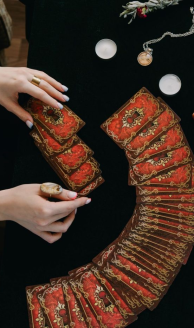
Photo: Mikhail Nilov, Pexels (Pexels License)
