
Tarot Card Meanings for Beginners: Where to Start
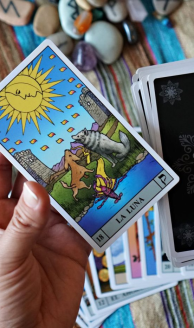
What is the difference between the Major and Minor Arcana?
The 22 Major Arcana cards point to the large themes of a life: identity, choice, loss, patience, change. Cards like The Fool, The Tower or The World rarely describe a single afternoon. They describe a chapter you are living through, which is why readers treat them as the backbone of the deck, and beginners usually start here.
The 56 Minor Arcana cards cover ordinary ground. A difficult coworker, a quiet week, a decision about money, a mood that passes by dinner. Four suits of fourteen cards each, and the numbers repeat in every suit, so the structure does most of the remembering for you. Read upright first, then notice what changes when a card lands reversed.
- The Major Arcana has 22 cards, numbered 0 to 21.
- The Minor Arcana has 56 cards across four suits.
- Majors describe themes that last weeks or months.
- Minors describe events, people and passing moods.
- Start with the Majors alone and add suits later.
How do the four suits work?
The Minor Arcana divides into four suits that map directly onto daily life. Each suit contains fourteen cards, running from Ace to Ten followed by Page, Knight, Queen and King. The suit and its element tell you where an experience takes place before you even look at the number.
- Wands represent fire, covering passion, energy, ambition and personal drive.
- Cups represent water, dealing with emotions, relationships, intuition and creative feelings.
- Swords represent air, focusing on thoughts, intellect, communication and mental challenges.
- Pentacles represent earth, reflecting material matters, work, money and physical reality.
When you are learning the cards, it often comes down to tracking these elements. Seeing several Swords in a reading tells you the issue sits in the mind, while a spread full of Pentacles points to practical, grounded circumstances. You can explore how these suits appear in practical spreads through the Rider Waite deck page on Tarot Readings Free.
Do I have to memorise all 78 cards?
No. Memorising 78 keyword lists is not the goal and it slows most beginners down. What matters is the picture in front of you, not a phrase you repeat from a book.
Every card carries four signals at once. The image shows a scene you can describe out loud. The suit sets the subject, so Cups point to feelings and Pentacles to money and work. The number sets the stage, with Aces as beginnings and Tens as endings. The position in the spread tells you who or what the card speaks about.
Read an unfamiliar card in three steps. Describe what the figures are doing before you name the card. Note the suit and number, then say what that combination suggests. Check the cards on either side, because a card shifts meaning next to others. The Rider Waite deck rewards this habit since the scenes are literal.
Should I start with the Rider Waite deck?
Starting with the Rider Waite deck gives you a practical foundation because every card features a detailed illustrated scene. Unlike older historical decks, where suit cards show a plain arrangement of pips, Pamela Colman Smith's scenes depict clear human actions, landscapes and expressions that make the meanings easy to read.
Most modern books, study guides, and online courses use these classic images as their standard reference. Understanding the imagery on these 78 cards makes it simple to transfer your knowledge to other decks later. You can view the complete card list on our Rider Waite deck guide to see how each scene supports personal reflection.
How do I practise tarot card meanings every day?
Ten minutes a day teaches you more than a weekend of cramming. Pull one card from your deck each morning and leave it face up where you will see it. That single card teaches you more than any list, because you meet it in your own day.
Describe the picture out loud before you reach for a book. Name what you see: who stands where, what they hold, which colours repeat. Then write one word and one question in a notebook, not an app. The word is your first reading. The question is what you carry into the day.
- Pull one card and note the date.
- Say the picture aloud in plain words.
- Write one word that fits the card.
- Write one question the card raises.
- Read the week's notes every Sunday.
At the end of the week, read back through your notes. Patterns appear that a single day hides. If you want a steady starting deck for this habit, look at the Rider Waite deck page, then try a free reading to see how the same card behaves in a spread.
How do reversed cards change a reading?
Reversed cards show the same core energy as upright cards, but that energy turns inward, faces a delay, or meets resistance. Instead of representing an external action or person, a reversed card often points to a personal reaction, an unexpressed feeling, or a boundary you need to set. The general topic of the card stays the same, so you do not need to learn a completely new list of definitions.
If you are just starting out, you can comfortably skip reversed cards during your first month of reading. Reading all 78 cards upright helps you build confidence with the primary themes without adding extra layers of interpretation. Turn every card upright until you feel steady with the basic symbols and card pairs.
When you decide to include reversals, let the surrounding cards guide your interpretation. A reversed card sitting next to strong, supportive cards usually indicates a temporary hesitation or a private reflection. If it lands next to difficult cards, it highlights a place where energy feels stuck or requires active patience.
What mistakes slow beginners down?
Most slow progress comes from a handful of habits rather than from the cards themselves. You switch decks every week, buy five books at once and read for friends before you can read for yourself. The result is noise, not skill.
A card is a prompt for reflection, not a fixed prediction. When you treat the Ten of Swords as a guaranteed ending, you stop listening to the question and start reciting a verdict. Stay with one deck, one question at a time, and write down what you notice.
- You jump between decks before you know one well, which resets your recognition of the images.
- You buy five books at once instead of finishing one and testing it against real readings.
- You read for other people too early, before you can sit with your own question calmly.
- You treat a card as a fixed prediction rather than a prompt for reflection.
- You ignore the question that was asked and answer a different one.
- You chase certainty about the future instead of noting what the card brings up now.
Frequently asked questions
How long does it take to learn tarot card meanings?
Most beginners feel comfortable with the Major Arcana in a few weeks of daily practice. The Minor Arcana takes longer because there are 56 cards, and many readers spend a year or more getting fluent with them. You do not need to know every card before you start reading.
Can I read tarot for myself as a beginner?
Yes. Reading for yourself is the safest way to practise because there is no pressure to perform. Keep your questions small and specific, and write down what you see before you check any book. Your own notes will teach you more than a keyword list.
Do I need a special deck to learn the meanings?
No, but a deck with clear scenes helps. The Rider Waite Smith images show the meaning inside the picture, which is why so many beginner guides use it. Any deck with illustrated pip cards will work for learning.
What if a card meaning does not match my situation?
That is normal and it is useful information. Tarot is a tool for reflection, not a fixed prediction, so a card that feels wrong often points to something you have not considered yet. Sit with it, note it, and see what the next reading shows.
Photo: DΛVΞ GΛRCIΛ, Pexels (Pexels License)
